
 EFFector Volume 38, Issue 15📍 The Sneaky Code Tracking App UsersWelcome to an all-new EFFector, your regular digest on everything digital rights from the Electronic Frontier Foundation. In our 850th issue: What Flock's new reforms really do, the censorious and privacy invasive bills advancing in the Senate, and an EFF investigation into mobile ad software. |
|---|
|
When you lose your rights online, you lose them in real life. Become an EFF member today! |
|---|
Featured Story: How Ad Libraries Encourage Apps to Leak Your Location
Across mobile platforms, advertising companies provide developers with software development kits (SDKs) that make it easy to monetize their apps. But those same SDKs can automatically feed users’ location data into ad systems that location data brokers use to track people. Many developers may not even be aware of this privacy violation, let alone the users who are directly affected. When developers let advertising SDKs collect location data, they’re putting users at risk of more than just creepy ads. Location information sourced from the advertising industry has been used for ICE investigations, global spy tools, outing a gay priest, tracking union organizers, and tracking US military personnel. A new EFF investigation has identified several advertising SDKs that publicly acknowledge collecting and sharing users’ location by default when embedded in Android apps granted location permissions. Defaults matter, not just for users, but for app developers as well. If app developers don’t pay close attention to the location-sharing settings of their advertising tools, they could inadvertently expose users’ location information. Our analysis found that advertising SDKs don’t just allow developers to share location data–they often encourage it. In some cases, after an app itself obtains location permission, advertising SDKs can separately obtain and share users’ location information without their knowledge or meaningful consent. Default settings, financial incentives, and unclear documentation can make sharing users’ location the easiest option for developers. Users can take extra steps to defend their location privacy, but they shouldn’t have to. Developers, regulators, and legislators must act to stop apps from leaking users’ location to advertising companies and data brokers.
EFF Updates🦜 FLOCK SQUAWKS 'REFORM': Amid nationwide anger that has seen scores of towns cancel or suspend their contracts with Flock Safety, the embattled surveillance vendor recently announced a handful of reforms. These reforms fall short. We should not be letting companies decide how much privacy we deserve. Policymakers must seize this moment—when even the leading ALPR vendor has admitted they have done too little to prevent abuse—to, at minimum, codify real protections into law. 🪪 KIDS ONLINE SAFETY ACT: Earlier this month, the Senate Commerce Committee voted to advance legislation that would dramatically expand age verification, and undermine privacy for everyone. The Kids Online Safety Act (KOSA), along with the CHATBOT Act and the Youth AI Privacy Act, would push companies to collect more information about their users while creating new incentives to restrict lawful speech. Congress should reject these bills (which still need approval from the full Senate) and instead pursue comprehensive privacy legislation that protects everyone—not just minors—without undermining privacy, security, or free expression. 🤐 INSTAGRAM CENSORSHIP: Access to accurate information about reproductive and maternal health can be critical. But on Meta's platforms, simply talking about prescription medication, abortion care, or one's own medical experiences can be enough to trigger content removals and account restrictions. That's why EFF recently submitted a public comment to the Meta Oversight Board in its consideration of a case involving an Instagram post about prescription drugs during pregnancy and childbirth. Users deserve a system in which rules aren't applied arbitrarily, appeals actually work, and vital health information isn't silenced because an automated system failed to understand its context. Meta can—and must—do better. 📺 LOOK MA, I'M ON TV: On a recent episode of Last Week Tonight, host John Oliver highlighted the Atlas of Surveillance, our searchable database documenting the tech police are using in thousands of communities across the country. "Flock cameras are just one part of a vast ecosystem," said Oliver. "If you now want to know what's being used in your town, you can check out resources like the EFF's Atlas of Surveillance, which catalogs each of the technologies used in your area. And I warn you, the answer probably isn't gonna make you happy." |
|---|
Support the Electronic Frontier Foundation
We're making sure technology serves all people—not just the powerful. Your contribution funds the attorneys, activists, and technologists who defend privacy, free expression, and human rights online—for everyone. Since 1990, EFF has led the charge for your digital rights. We're powered by members, and we need you in this fight. |
|---|
"We have to fight and win on the digital terrain to organize, to speak freely, to access healthcare, to find work, to receive an education, to participate fully in democracy."EFF Executive Director Nicole Ozer on how digital rights have become fundamental to our lives. 
MiniLinks🗣️ Free Speech
🔒 Privacy
🔍 Transparency 🗝️ Security
AnnouncementsEFF Events
Corporate Giving and Sponsorships
|
|---|
Fresh EFF Gear Is Here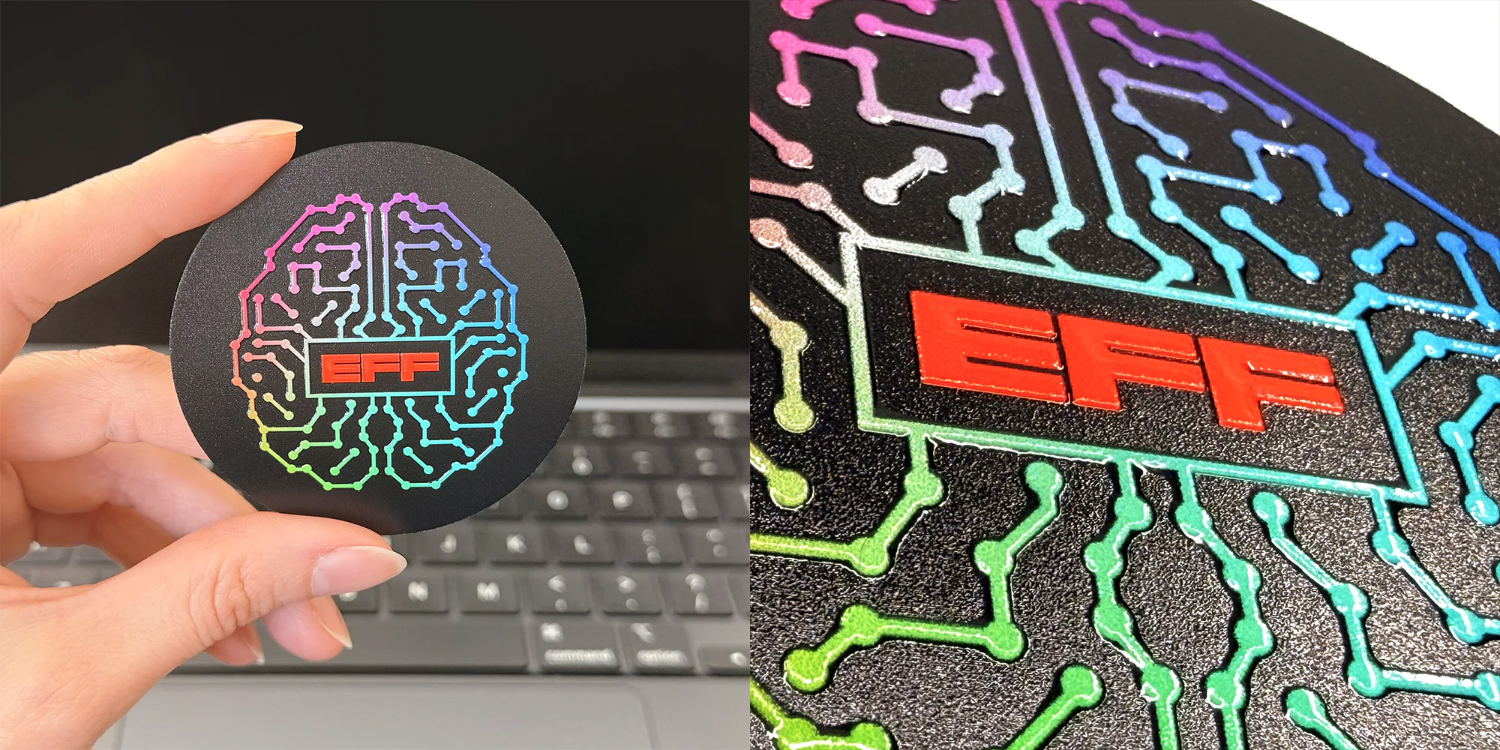
Show off your support for EFF with hot digital rights merch from our online store. Just in: an EFF circuit-board brain sticker with a textured finish that's as distinctive to touch as it is to look at. In addition to EFF shirts and hoodies, we have a wide variety of freedom-supporting swag in stock, including (extremely popular) liquid core gaming dice, HTTP playing cards, and a tactile Lady Justice braille sticker. |
|---|

AdministriviaEFFector is a publication of the Electronic Frontier Foundation. Editor: editor@eff.org Membership and donation queries: membership@eff.org General EFF, legal, policy, or online resources queries: info@eff.org
Reproduction of this publication in electronic media is encouraged. MiniLinks do not necessarily represent the views of EFF.
About EFFThe Electronic Frontier Foundation is the leading nonprofit defending online civil liberties. We promote digital innovation, defend free speech, fight illegal surveillance, and protect rights and freedoms for all as our use of technology grows. Find out more at https://www.eff.org/.
This message is printed from 100% recycled electrons. EFF appreciates your support and respects your privacy.
|
|---|
